A Beginner’s Guide to Training Zones (VO2 Max) and Thresholds

Diving into fitness introduces a world rich with specialized terms like “Lactate Threshold”, “Ventilatory Threshold”, and “VO2 max”. Understanding these concepts is pivotal for devising an effective workout plan that adapts to your training zones. It is also important for cardio training. This post aims to simplify these terms for fitness enthusiasts at all levels.
Thresholds and Their Importance
Thresholds indicate how your body responds to various exercise intensities, guiding you to optimize your training for maximum efficiency without risking overtraining. At the core of tailored endurance training plans are training zones, determined by key physiological marker thresholds: Lactate Threshold (LT) and Ventilatory Threshold (VT). These thresholds indicate the shifts from aerobic and anaerobic energy production.
Training Zones (VO2 Max) Explained
Physiological markers like VO2 max represent your body’s maximum oxygen utilization during intense activity and can define training zones. Training zones are exercise intensity ranges targeting specific energy systems linked to heart rate or exertion levels. Training zones exist at different scales including 3 zones and 5 zones. They are measured in terms of: % of VO2 Max, % of Max Heart Rate, and amount of lactate. Seiler (2010) describe the Norwegian Olympic Federation’s five-zone intensity scale in terms of VO2 Max and Heart Rate as:
- Zone 1 (50-65% of VO2 Max or 60-72% of Max Heart Rate)
- Zone 2 (66-80% of VO2 Max or 72-82% of Max Heart Rate)
- Zone 3 (81-87% of VO2 Max or 82-87% of Max Heart Rate)
- Zone 4 (88-93% of VO2 Max or 88-92% of Max Heart Rate)
- Zone 5 (94-100% of VO2 Max or 93-100% of Max Heart Rate)
At the bounds of these zones are Lactate Thresholds (LT) and Ventilatory Thresholds (VT). Before Zone 1, you are primarily using oxygen for energy. Surpassing Zone 1 means you have exceeded the aerobic threshold (LT1 and VT1) and are using oxygen and stored energy. Surpassing Zone 2 means you have exceeded the anaerobic threshold (LT2 and VT2) and your stored energy is the primary energy source.
The training zones identified VO2 Max can be used to guide your training as described in our “VO2 Max: What is it and how do we train it?” article.
Aerobic Threshold vs. Anaerobic Threshold
The shift from aerobic (using oxygen) to anaerobic (not requiring oxygen) energy production is a vital intensity marker, indicating when your body begins to rely more on stored energy. You can observe this shift at two points commonly referred to as:
- Aerobic Threshold: Increased anaerobic energy usage is required when aerobic energy production falls short.
- Anaerobic Threshold: Where anaerobic metabolism becomes the primary energy source.
Understanding these thresholds helps identify effective training zones for enhancing endurance and fitness. The lactate threshold (LT) and ventilatory threshold (VT) are based on the aerobic and anaerobic thresholds.
Lactate Threshold (LT) and Ventilatory Threshold (VT)
Lactate threshold (LT) occurs when the body produces lactate at a rate faster than it can clear it, marking the point where lactate accumulates. It has two key stages:
- LT1: Marks the aerobic threshold with initial lactate accumulation.
- LT2: Represents the anaerobic threshold with significant lactate buildup.
Ventilatory thresholds (VT) reflect metabolic changes through breathing patterns and gas exchange, pinpointing when aerobic metabolism shifts to anaerobic. The two VT stages are:
- VT1: Increased ventilation without extra oxygen intake, indicating the beginning of anaerobic metabolism.
- VT2: Further increase in ventilation to compensate for acidosis from anaerobic metabolism.
Testing for lactate threshold is invasive. Therefore, testing for VO2 Max provides an alternative method for identifying your training zones.
Identifying Your Training Zones
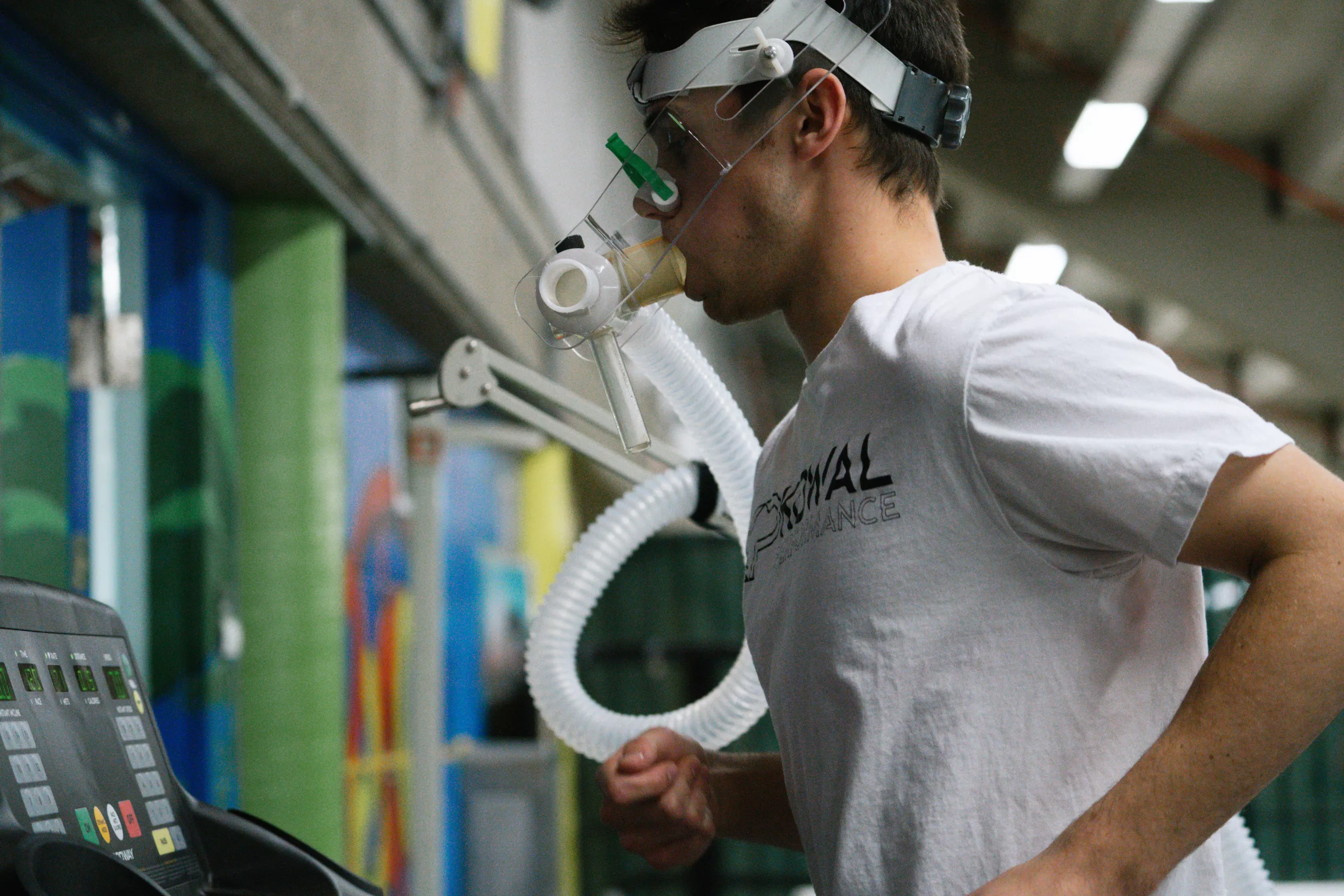
To establish your training zone, a graded exercise test with a metabolic cart (VO2 Max test) is crucial to accurately determine your aerobic and anaerobic thresholds. The VO2 Max test analyzes ventilation and gas exchange, and offers a non-invasive alternative to lactate testing, simplifying the process of tailoring your training to your physiological profile. Based on the VO2 Max test, you can determine the percentage that you need to maintain your heart rate to belong in a specific training zone.
Professional Guidance: The Way Forward
Grasping LT, VT, and VO2 max principles is essential for optimizing training effectiveness. We recommend finding a health professional well versed in cardio fitness to help identify your optimal training zone.
If you are in Edmonton, our clinic offers professional guidance and VO2 max testing to improve your cardio training and fitness.
References
Seiler, Stephen. “What is best practice for training intensity and duration distribution in endurance athletes?.” International journal of sports physiology and performance 5.3 (2010): 276-291.
Integrating his research background in applied anatomy of human movement and his practice as a certified strength and conditioning coach, Ruben deploys his unique skill set to help his clients return to an active lifestyle, maximize their performance, and reduce injuries. Ruben has completed advanced training in manual therapy, back disorders, and exercise and osteoarthritis. He’s also a certified Olympic weightlifting coach. In treatment, Ruben focuses on exercise therapy in combination with hands-on manual therapy. Education is the cornerstone of his practice, and Ruben takes extra time to ensure his clients are actively engaged and informed about their treatment and recovery.